
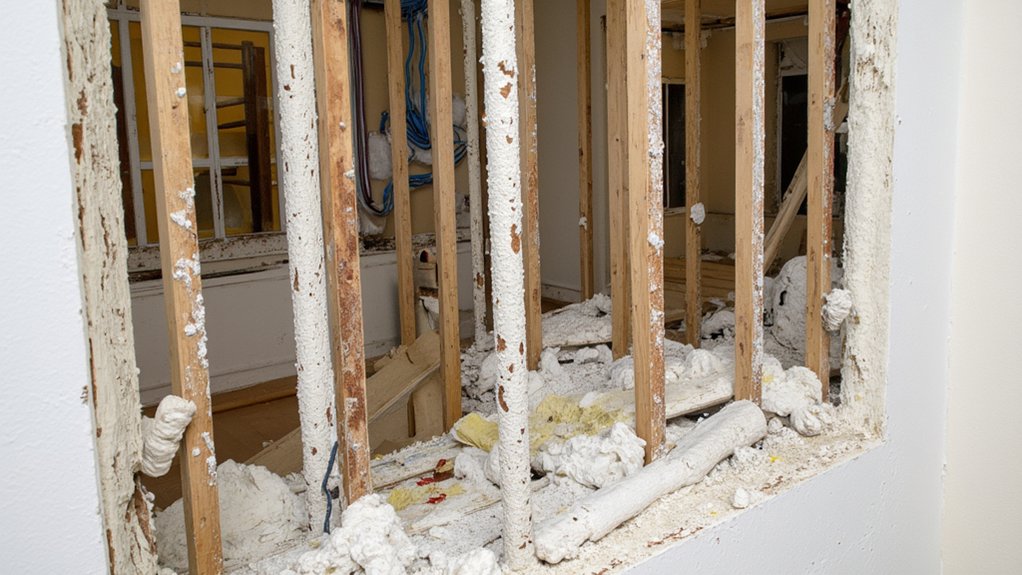
You’ll find much more than just a solid surface when you examine what’s behind your plaster walls. The intricate system concealed within includes wooden lath strips, insulation materials, and crucial utility networks that keep your home functioning. According to master plasterer John Smith, “The hidden layers work together like a carefully orchestrated system.” Let’s explore these essential components and discover how they create the sturdy, functional walls you rely on every day.
The Basic Anatomy of a Plaster Wall System
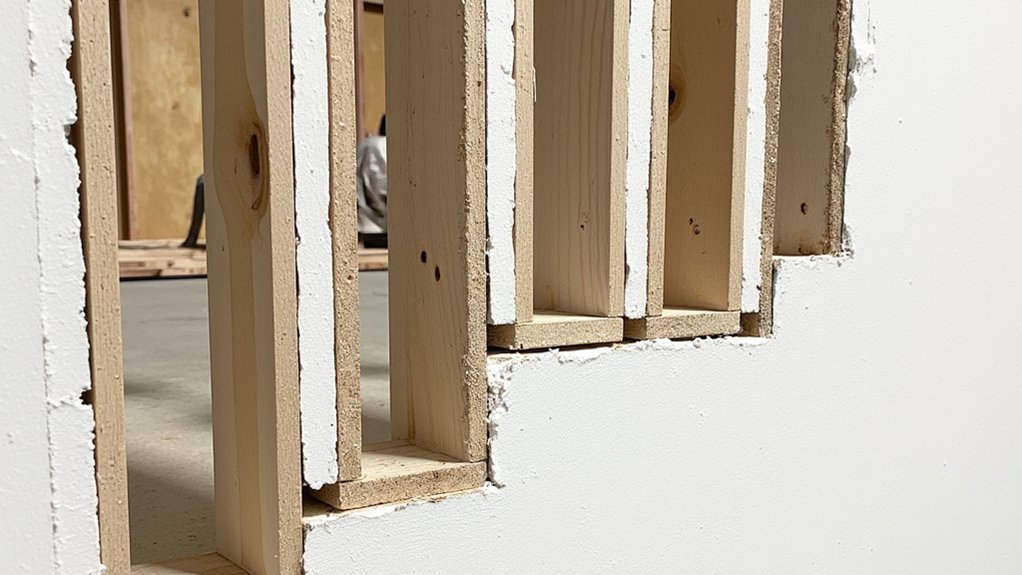
Three main components make up a traditional plaster wall system: wooden lath strips, a scratch coat, and a finish coat.
The wooden lath strips, typically measuring 1.5 inches wide and spaced ¼ inch apart, create the foundation. You’ll find these strips nailed horizontally across the wall studs, forming a sturdy base for the plaster layers.
The scratch coat, which is about ⅜ inch thick, pushes through the lath gaps to form “keys” that lock the plaster in place. “These keys are essential for the wall’s structural integrity,” notes master plasterer Jim Davis.
The finish coat, approximately ⅛ inch thick, provides the smooth surface you’ll see. It’s made of finer plaster materials than the scratch coat and creates that characteristic hard, durable surface that’s stood the test of time.
Essential Support Components and Infrastructure
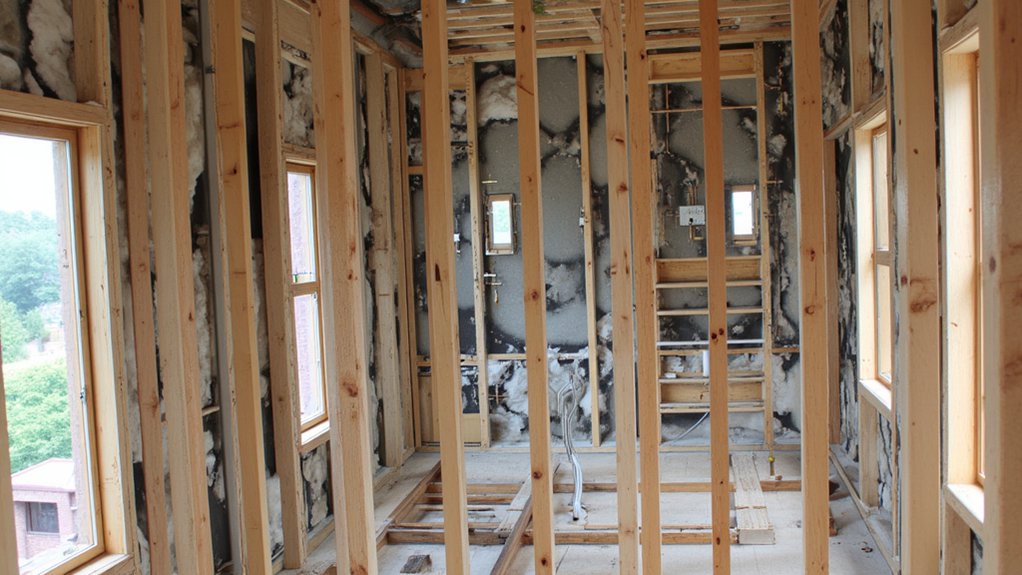
Behind every well-built plaster wall system, you’ll find critical support elements that guarantee long-term stability and proper installation.
Key Infrastructure Components:
- Wood or metal lath strips (spaced 1/4 inch apart)
- Support blocking (16 inches on center)
- Wire mesh reinforcement
- Corner beads and expansion joints
“The strength of your plaster wall depends heavily on proper backing material installation,” says master plasterer Tom Wilson. You’ll need to verify:
- Solid attachment points every 6-8 inches
- Moisture barrier placement between framing and lath
- Proper wall cavity depth (minimum 3-5/8 inches)
Additional Support Features:
- Plumbing and electrical chases
- Insulation barriers
- Sound-dampening materials
- Cross bracing at corners and openings
These components work together to create a durable foundation for your plaster application.
Types of Insulation Behind Plaster Walls
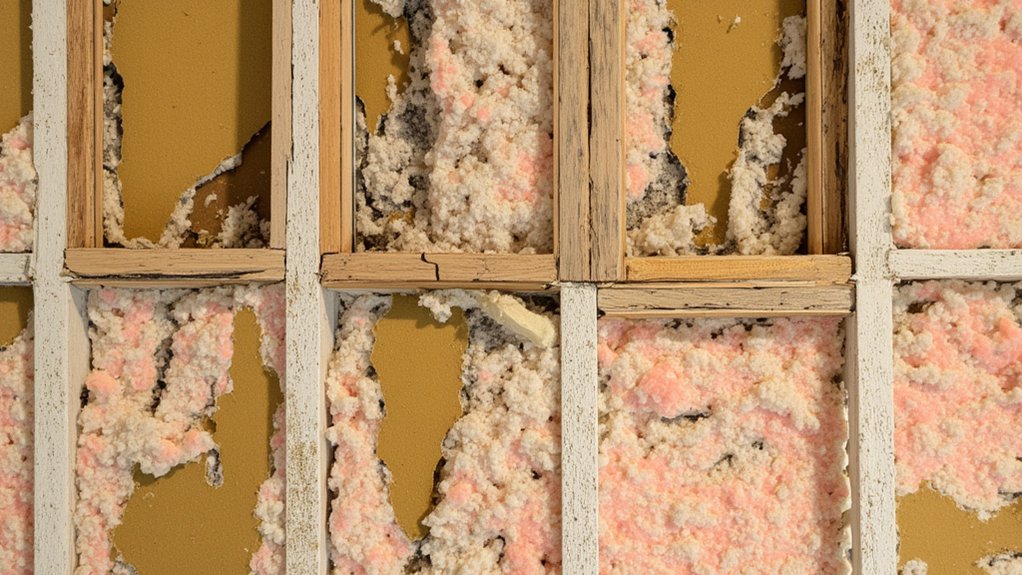
When examining plaster walls in older homes, you’ll typically discover several common types of insulation materials that builders historically used for temperature control and soundproofing.
Common insulation types include:
- Rock wool (mineral wool) – Dense fibers providing R-value of 3.0-3.7 per inch
- Newspaper (cellulose) – Treated, shredded paper reaching R-3.8 per inch
- Wood shavings – Low-cost option with R-2.5 per inch rating
- Horsehair plaster – Natural fibers mixed with lime offering R-0.5 per inch
“Early 1900s builders often combined multiple insulation layers for maximum effectiveness,” notes architectural historian Dr. Sarah Bennett. You’ll also find empty cavities in some walls, as insulation wasn’t required by building codes until the mid-20th century. Modern renovations frequently upgrade these spaces with blown-in cellulose or foam insulation to meet current energy standards.
Electrical, Plumbing, and Utility Networks
Plaster walls in older homes often conceal complex networks of electrical wiring, water pipes, and other essential utility systems installed during different renovation periods.
Behind your plaster walls, you’ll typically find:
- Electrical wiring: Knob-and-tube in pre-1940s homes or modern Romex cables
- Supply pipes: 1/2″ to 1″ copper or galvanized steel water lines
- Drain pipes: 1-1/2″ to 4″ cast iron or PVC waste lines
- Gas lines: 1/2″ to 1″ black iron pipes
- Communication lines: Phone, cable, or internet wiring
“Most utility systems in plaster walls require careful mapping before any renovations,” says contractor Mike Thompson. “You’ll need to locate these components using specialized tools like wire detectors and pipe scanners to avoid damage during repairs or remodeling.”
Remember that building codes often require access panels for major junction points and shutoff valves.
Common Structural Elements and Framing
Beyond the utility systems, the structural framework supporting your plaster walls consists of several key components working together.
Your walls’ main structure includes:
- Vertical studs: 2×4 wooden supports spaced 16 inches apart
- Top plates: Double horizontal beams securing studs at ceiling level
- Bottom plate: Single horizontal beam anchoring studs to floor
- Fire blocks: Horizontal supports between studs to prevent fire spread
- Diagonal bracing: Corner supports for stability
“The quality of framing directly impacts wall integrity and longevity,” notes master carpenter Jim Reynolds. You’ll typically find wood lath strips nailed horizontally across these studs, spaced about 1/4 inch apart. In newer homes, metal mesh or drywall may replace traditional lath. Load-bearing walls contain additional structural reinforcement, including doubled-up studs and headers above doorways and windows.
Historical Methods Vs Modern Construction Techniques
Although traditional plastering methods date back centuries, today’s construction techniques have evolved dramatically from those labor-intensive historical approaches. In historical plastering, craftsmen would apply three distinct coats – scratch, brown, and finish – using natural materials like lime, sand, and horsehair.
Modern techniques rely on drywall panels and premixed joint compounds for faster installation. You’ll find that while traditional plaster walls took days to complete, today’s methods can finish a room in hours. Here’s what’s changed:
Historical Methods:
- Hand-mixed lime plaster
- Wood lath strips for base
- 3-7 day curing time
Modern Techniques:
- Gypsum drywall panels
- Self-adhesive mesh tape
- Ready-mixed compounds
- 24-48 hour completion time
