
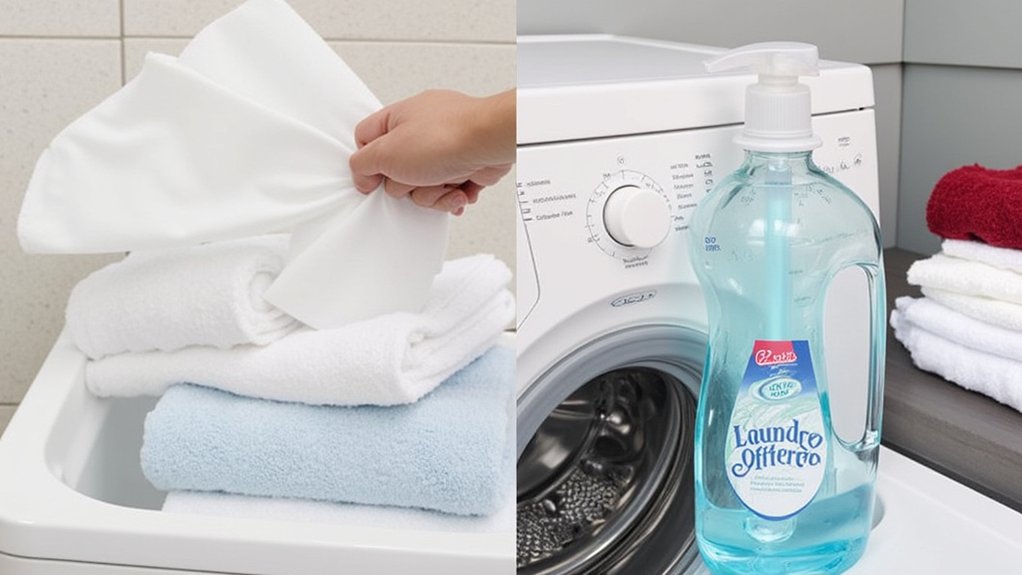
Just like choosing between paper or plastic at the grocery store, you’ll face the choice between fabric softener sheets and liquid softener in your laundry routine. The decision impacts everything from your clothes’ softness to your environmental footprint. While both options promise to eliminate static and wrinkles, they work through distinctly different mechanisms that affect your laundry’s final results. Understanding these key differences will help you make the most cost-effective and efficient choice for your specific needs.
How Each Type Works: Breaking Down the Science
While both fabric softeners serve the same ultimate purpose, they work through distinctly different mechanisms to soften and freshen your laundry.
Liquid softeners use their molecular composition to coat your clothes during the rinse cycle. They contain positively charged surfactant properties that bond to the fabric fibers, creating a thin, protective layer that feels soft to touch.
Dryer sheets, on the other hand, rely on heat activation. When you toss them in the dryer, the warming process releases their softening agents. These sheets transfer a coating of chemicals that reduce static electricity and add a layer of softness to your clothes.
The key difference lies in timing: you’ll add liquid softener during washing, while dryer sheets work their magic during the drying process.
Cost Analysis and Value Comparison
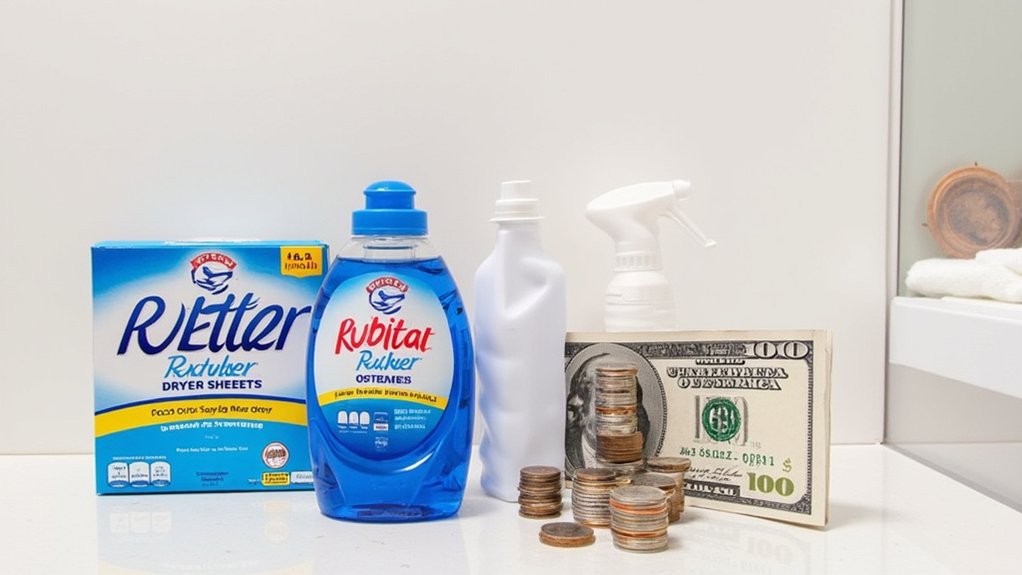
Three key factors determine the true cost-effectiveness of fabric softeners: price per load, longevity of the product, and the frequency of use.
When you’re making budget considerations, you’ll find that liquid softeners typically cost $0.15-0.25 per load, while dryer sheets average $0.05-0.10 per load. According to laundry expert Sarah Thompson, “Liquid softeners last 2-3 months with regular use, while a box of dryer sheets can extend to 4-6 months.”
Price comparison between types:
- Liquid: $8-12 per 48-64 oz bottle
- Sheets: $5-8 per 120-count box
You’ll need to factor in that liquids require precise measuring, while sheets offer straightforward, single-unit dosing. However, liquid softeners often come with concentrated formulas, allowing you to use less product per load.
Environmental Impact and Sustainability
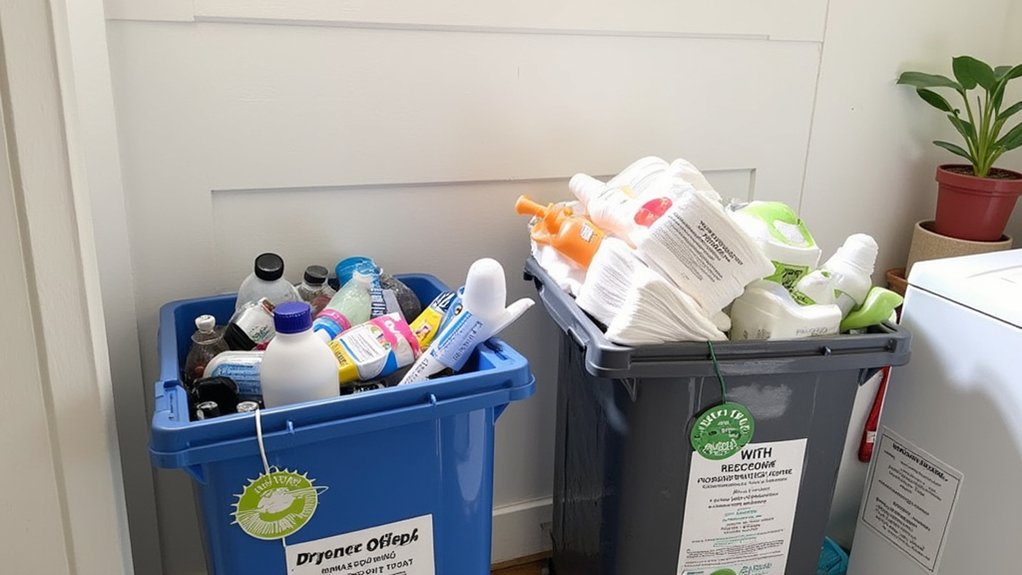
Beyond the cost considerations, both fabric softening methods have distinct environmental footprints that can impact your eco-conscious decisions. Dryer sheets are typically single-use and non-biodegradable, contributing to landfill waste with their polyester materials. Liquid softeners, while recyclable in their containers, often contain chemicals that can harm aquatic ecosystems.
Consider these eco-friendly alternatives:
- Wool dryer balls (reusable for 1,000+ loads)
- White vinegar (1/2 cup per wash)
- Baking soda solutions (1/4 cup per load)
Recycling options:
- Rinse liquid softener bottles thoroughly
- Check local recycling guidelines for proper disposal
- Repurpose dryer sheets as dust cloths
“The shift toward natural fabric softening methods can reduce household chemical use by 87%,” notes environmental scientist Dr. Sarah Chen.
Effectiveness on Different Fabric Types
Although both fabric softening methods can effectively treat clothes, their performance varies considerably across different textile types.
For cotton performance, you’ll find that liquid softeners penetrate deeper into fibers, providing superior softness and static control. According to textile expert Dr. Sarah Chen, “Liquid softeners reduce wrinkles in cotton items by up to 50% more effectively than sheets.”
When it comes to synthetic fabrics:
- Dryer sheets work better on polyester and nylon
- Sheets leave less residue on moisture-wicking athletic wear
- Liquid softeners may reduce the breathability of performance fabrics
For ideal results with specialty items:
- Use sheets for: fleece, microfiber, and athletic wear
- Choose liquid for: towels, cotton bedding, and denim
- Avoid both on: swimwear, flame-resistant clothing, and infant sleepwear
Storage, Convenience, and Ease of Use
Both fabric softening options present distinct storage and handling considerations that can impact your laundry routine’s efficiency. Dryer sheets require minimal space and don’t need special storage solutions – you can keep them in their original box or transfer them to a drawer. They’re lightweight and won’t leak or spill.
Liquid softener demands more careful handling and dedicated storage space. You’ll need to store the bottle upright to prevent leakage, and it’s heavier to maneuver between usage scenarios. According to laundry expert Sarah Thompson, “Liquid softeners require precise measuring and timing during the rinse cycle, while sheets are simply tossed in the dryer.”
Consider your space constraints:
- Sheets: 1-2 cubic feet of storage
- Liquid: 3-4 cubic feet, plus measuring cup space
- Temperature requirements: Liquid needs room temperature storage
Common Problems and Solutions
While proper storage and handling contribute to success with fabric softeners, users frequently encounter specific challenges with each format.
Common Sheet Problems:
- Sheets sticking together in the box
- Uneven fabric freshness distribution
- Static cling returning before wash cycle ends
Solutions:
- Store sheets in a sealed container
- Use only one sheet per load
- Add sheet at cycle’s start
Common Liquid Problems:
- Dispensing excessive amounts
- Staining or spotting on clothes
- Build-up in washing machine
Solutions:
- Use measuring cap precisely
- Dilute with water before adding
- Run monthly cleaning cycle
Pro Tip: “If you’re experiencing static cling, try using half a dryer sheet or reducing liquid softener by 25%,” recommends laundry expert Sarah Chen.
Frequently Asked Questions
Can Fabric Softener Sheets and Liquid Be Used Together in One Load?
You shouldn’t combine products by using fabric softener sheets with liquid softener in one load, as this can lead to over-softening and leave residue on your clothes.
Are Fabric Softeners Safe to Use Around Pets and Children?
You’ll need to be careful with fabric softeners around pets and children. For fabric safety and pet health, avoid direct contact and store products securely. Consider natural alternatives when possible.
Do Fabric Softeners Affect the Fire-Retardant Properties of Children’s Sleepwear?
You shouldn’t use fabric softener types on children’s sleepwear, as they’ll reduce fire-retardant effectiveness. Current sleepwear regulations require flame resistance, and softeners can compromise this important safety feature.
Can Fabric Softeners Help Reduce Pet Hair on Clothes?
You’ll notice less pet hair on clothes when you add fabric softeners to your wash. These washing tips work because softeners reduce static cling that attracts pet hair.
How Long Do the Scents From Fabric Softeners Typically Last After Washing?
Think you’ll smell like a spring meadow forever? Sorry! Your clothes’ scent longevity typically lasts 1-2 weeks, with fragrance strength gradually fading after each wear and wash you put them through.
