
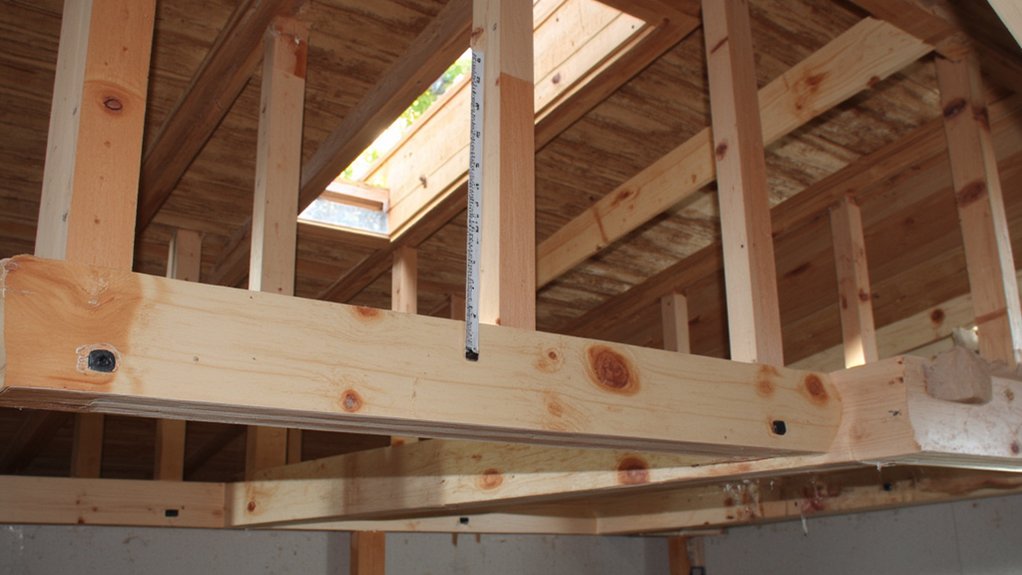
When it comes to mounting objects overhead, your ceiling studs are like the Atlas of your home – silently bearing the weight above. You’ll need to carefully consider several factors before hanging that cherished chandelier or suspending workout equipment, as different stud types can support varying loads. Understanding your ceiling’s structural capacity isn’t just about the numbers – it’s about ensuring your family’s safety and preventing costly repairs down the line.
Understanding Ceiling Stud Construction and Materials
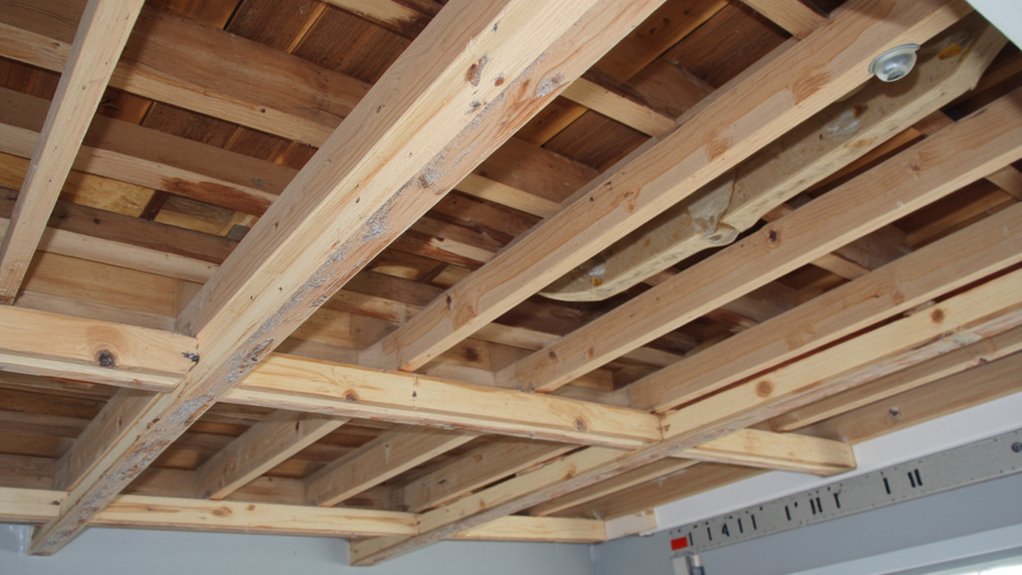
Ceiling studs, also known as ceiling joists, form the essential framework that supports your home’s upper structure and attached fixtures. You’ll typically find these structural members made from dimensional lumber like 2×6, 2×8, or 2×10 boards, spaced 16 or 24 inches apart.
Common ceiling stud materials include:
- Pine or Douglas fir (most residential applications)
- Engineered wood (TJI joists)
- Steel (commercial buildings)
According to master carpenter Tom Silva, “The size and spacing of ceiling joists directly impact their load-bearing capacity.” Modern building codes require ceiling joists to support both dead loads (permanent weight) and live loads (temporary weight). Your joists’ span, species of wood, and grade rating will determine their specific weight capacity, with standard residential joists typically rated for 40-50 pounds per square foot.
Maximum Weight Capacity by Stud Type
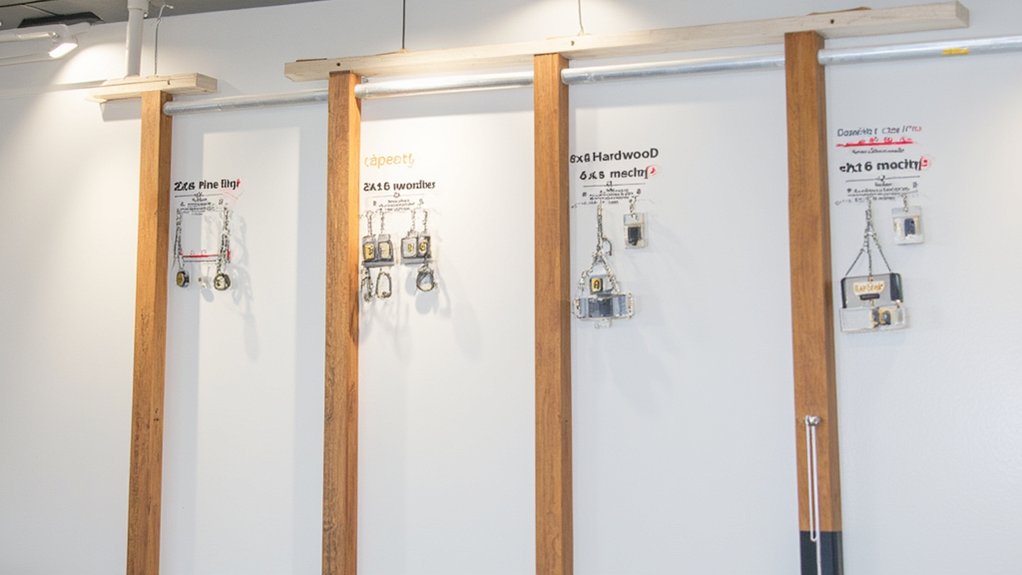
When choosing the right support for your overhead fixtures, you’ll need to understand the specific weight limits for different stud types.
Standard Weight Capacities:
- 2×4 wooden studs: 20-40 pounds
- 2×6 wooden studs: 50-70 pounds
- Metal studs (light gauge): 15-25 pounds
- Metal studs (heavy gauge): 30-50 pounds
“The actual load capacity depends on how you’re mounting items and the stud’s spacing,” explains contractor Mike Roberts. You’ll find most ceiling studs installed 16 or 24 inches apart, which affects their strength.
For maximum safety:
- Wood studs can support more weight when properly reinforced
- Metal studs work best with specialized mounting hardware
- Never exceed 75% of the rated capacity
- Consider using multiple studs for heavy fixtures
Factors That Impact Load-Bearing Capability
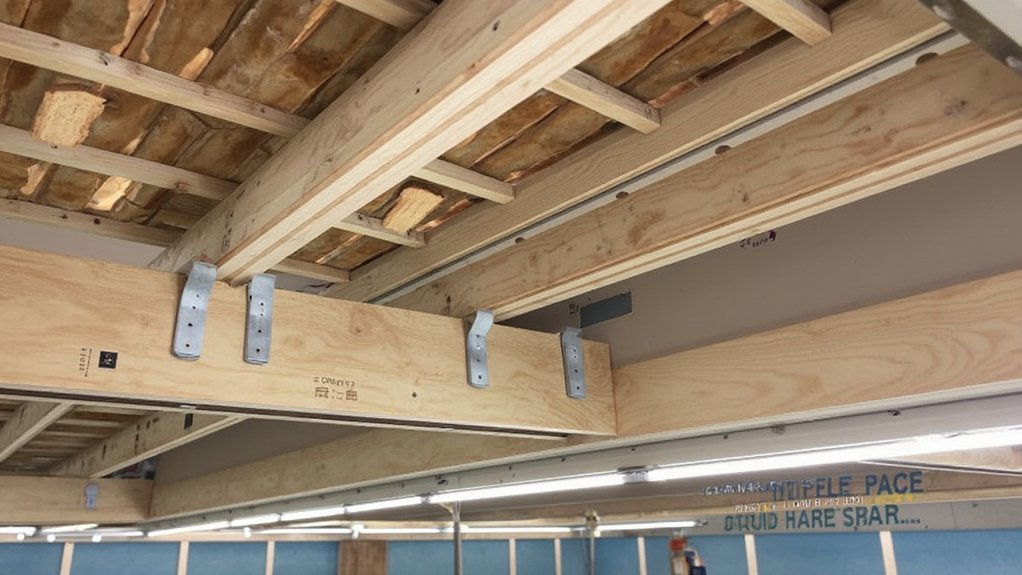
Understanding a stud’s maximum weight capacity requires looking beyond just the basic ratings we covered above. Several key factors will affect how much weight your ceiling studs can safely hold:
- Stud spacing – The closer your studs are placed together, the more distributed the weight load becomes
- Wood quality – Grade differences and knots can reduce a stud’s strength by up to 30%
- Moisture content – High humidity levels weaken wood fibers considerably
- Age of materials – Older studs may have deteriorated over time
- Installation method – Improper nailing patterns reduce load capacity
- Additional support – Cross-bracing and blocking increase overall strength
“You’ll need to evaluate the complete structural system, not just individual components,” says Tom Miller, structural engineer. “Even minor issues like loose fasteners can impact a stud’s performance.”
Safe Installation Methods and Best Practices
To guarantee your ceiling can safely support heavy loads, proper installation techniques are absolutely essential from the start. Here’s how to do it right:
- Locate ceiling joists using a stud finder
- Mark joist centers with painter’s tape
- Pre-drill pilot holes at marked locations
- Use appropriate mounting hardware:
- For loads under 20 lbs: Toggle bolts
- For 20-50 lbs: Lag screws (min. 1/4″)
- For 50+ lbs: Through-bolts with washers
“Always drill pilot holes slightly smaller than your mounting hardware,” says contractor Mike Stevens. “For lag screws, use a 3/16″ bit for 1/4″ screws.”
When mounting, verify screws penetrate at least 2.5″ into the joist. Double-check all hardware is tight and level before adding weight.
Common Mounting Hardware and Weight Limits
The right mounting hardware makes all the difference in safely securing items to your ceiling joists. Here’s what common mounting options can typically support:
- Lag bolts (3/8-inch): Up to 100 pounds
- Toggle bolts (3/8-inch): 50-75 pounds
- Molly bolts: 25-50 pounds
- Heavy-duty ceiling hooks: 20-35 pounds
- Drywall anchors: 10-25 pounds
“Always match your hardware to both the weight of your item and the specific type of ceiling construction,” says contractor Mike Reynolds. You’ll want to use a stud finder to locate joists for heavy items, then pre-drill pilot holes to prevent wood splitting. For additional security, distribute weight across multiple mounting points when possible. Remember that dynamic loads (moving or swinging items) require stronger hardware than static loads.
Signs of Ceiling Stud Stress and Overloading
Recognizing five key warning signs can help you identify when ceiling studs are under dangerous stress from excess weight.
Look for these critical indicators:
- Visible sagging or drooping in your ceiling, even if slight
- Cracks forming along the drywall, especially near mounting points
- Popping or creaking sounds when weight shifts overhead
- Visible gaps between the ceiling and crown molding
- Doors or windows that suddenly stick or won’t close properly
“Any deformation exceeding 1/360 of the span length indicates dangerous load stress,” warns structural engineer Tom Miller. You’ll want to measure the deflection: for a 12-foot span, anything over 0.4 inches requires immediate attention. If you notice multiple warning signs, remove mounted items immediately and consult a professional to prevent potential structural failure.
Professional Assessment and Support Solutions
When these warning signs appear, scheduling an inspection with a qualified structural engineer or licensed contractor becomes your next important step. “Professional assessments typically take 2-3 hours and cost between $300-500,” explains building inspector Sarah Chen.
During your assessment, the professional will:
- Calculate your ceiling’s actual load capacity
- Identify weak points in the support structure
- Test joist integrity and spacing
- Measure deflection rates
Common support solutions they might recommend include:
- Installing additional ceiling joists (16-inch spacing)
- Adding cross-bracing between existing studs
- Installing support beams or load-bearing walls
- Reinforcing weak joists with sister beams
“Don’t wait until you see severe sagging – early intervention prevents costly structural repairs,” advises contractor Mike Torres. You’ll receive a detailed report outlining necessary repairs and weight limits.
