
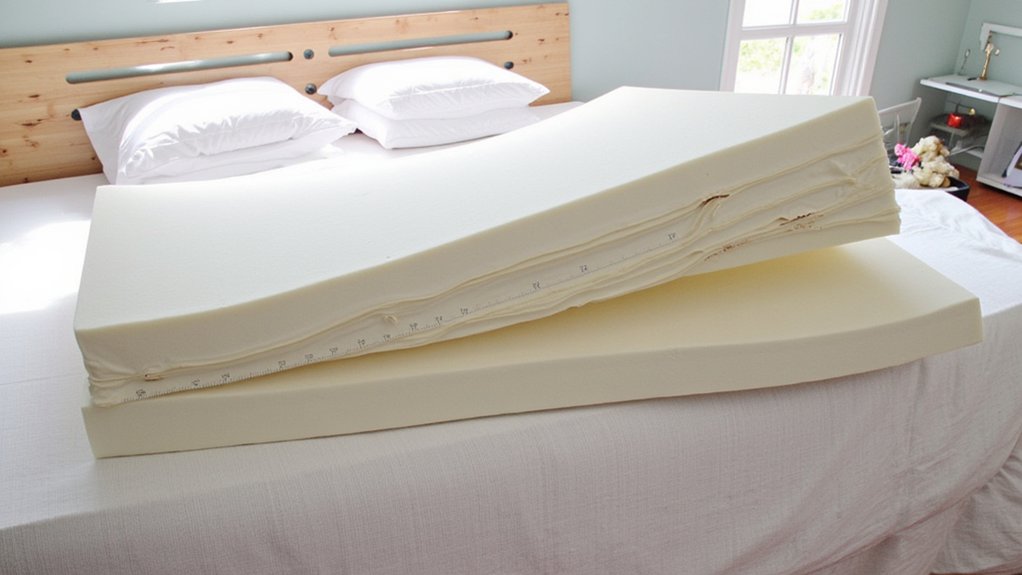
If you’ve just purchased a new mattress topper, you’ll need to plan ahead for its expansion time before sleeping on it. According to sleep experts, most memory foam toppers require between 6 to 72 hours to fully expand, depending on their thickness and material composition. “The expansion process is vital for achieving maximum comfort and support,” notes Dr. Sarah Chen, sleep specialist at the National Sleep Institute. Let’s explore what affects your topper’s expansion time and how you can guarantee proper results.
Typical Expansion Times for Different Memory Foam Toppers
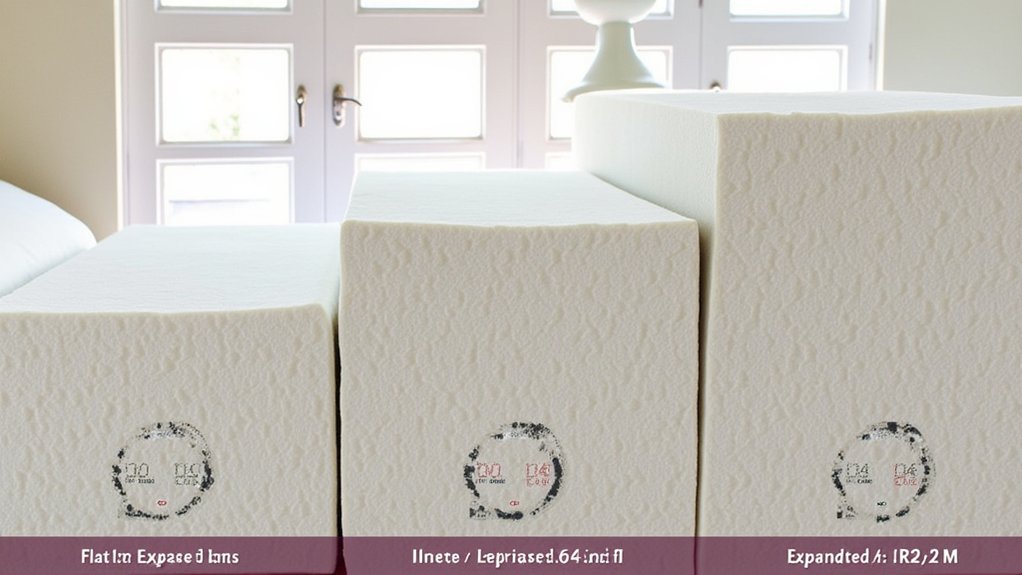
While most memory foam mattress toppers begin expanding immediately after unboxing, their full expansion times can vary greatly based on thickness and density.
Different memory foam types expand at varying rates:
- 2-inch standard memory foam: 6-8 hours
- 3-inch high-density foam: 24-48 hours
- 4-inch gel-infused foam: 24-72 hours
“Density differences play a significant role in expansion time,” explains Dr. Sarah Chen, sleep materials expert. “Higher-density foams (5+ pounds per cubic foot) typically need longer to reach full thickness.”
For best results:
- Unbox your topper in a warm room (68-72°F)
- Allow extra time in cold conditions
- Gently pull corners to help shape
- Wait full expansion time before use
Remember that some density variations may require up to 72 hours for complete expansion.
Factors That Affect Your Topper’s Expansion Rate
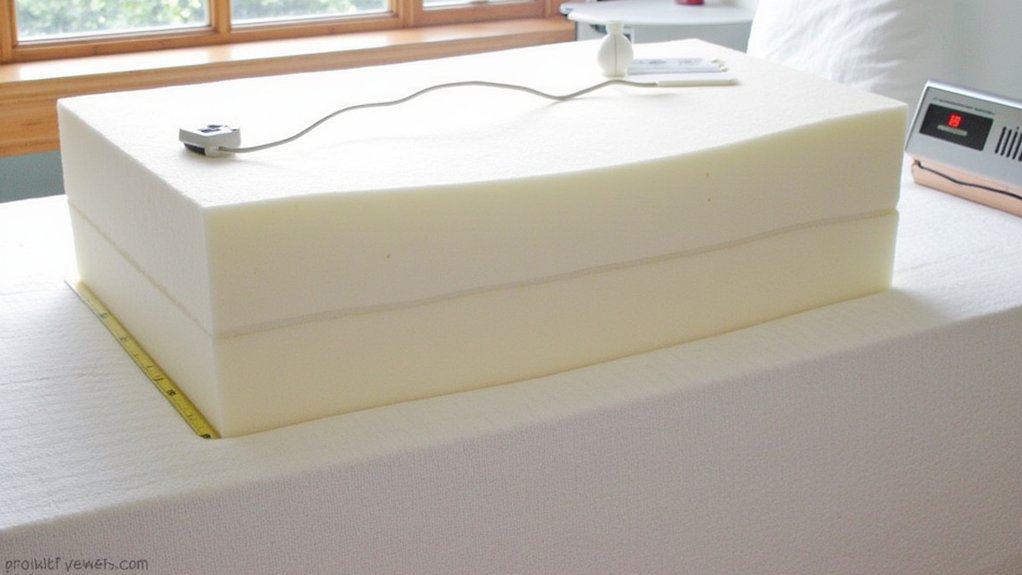
Although a mattress topper’s expansion time largely depends on its materials, several environmental and handling factors can markedly impact how quickly it reaches full thickness.
Room temperature plays an essential role – warmer rooms (68-75°F) help memory foam expand faster than cold spaces. Your topper’s material composition affects expansion too, with gel-infused foam typically expanding slower than traditional memory foam. The topper thickness is another key factor; 4-inch toppers usually take longer to expand than 2-inch versions.
Other factors that influence expansion rates include:
- Humidity levels (40-60% is ideal)
- How long the topper stayed compressed in packaging
- Whether you unroll it properly and remove packaging completely
- Air circulation in the room
Steps to Speed Up the Expansion Process

Several practical steps can help accelerate your mattress topper’s expansion time after unboxing it. Follow these proven methods to speed up the process:
- Place your topper in a warm room (72-78°F) as heat helps different material types expand faster
- Gently walk on the topper while wearing clean socks to distribute pressure evenly
- Use a hairdryer on low heat, keeping it 6-8 inches away from the surface
“Proper storage tips before installation can impact expansion time considerably,” says sleep expert Dr. Sarah Chen. “Always store your topper flat, not rolled, in room temperature conditions.”
Additional acceleration techniques:
- Open windows for ventilation to release manufacturing odors
- Carefully pull corners outward to encourage stretching
- Allow direct sunlight exposure for 2-3 hours
- Flip the topper every few hours during expansion
Signs Your Mattress Topper Has Fully Expanded
Recognizing when your mattress topper has fully expanded involves checking specific physical indicators and measurements that confirm proper inflation.
During your topper inspection, look for these key expansion indicators:
- The corners are fully extended and squared off
- The surface feels consistently firm across all areas
- There are no lumps, dips, or compressed sections
- The topper has reached its advertised thickness
- All packaging creases have disappeared
You can verify complete expansion by measuring the topper’s height with a ruler – it should match the product specifications. “A fully expanded memory foam topper will spring back immediately when you press it,” explains sleep expert Dr. Sarah Chen. If your topper exhibits these signs and maintains its shape, you can be confident it’s ready for use.
Common Issues During the Expansion Phase
Many mattress topper owners face unexpected challenges while waiting for their new purchase to expand properly. Here are the most common expansion problems you’ll want to watch for:
- Uneven expansion – Some sections may expand faster than others, creating temporary lumps
- Corner curling – Edges might remain rolled up for 24-48 hours
- Persistent creases – Deep packaging folds can take up to 72 hours to disappear
- Temperature sensitivity – Cold rooms can slow expansion by 50%
“Room temperature between 68-72°F provides ideal expansion conditions,” notes sleep expert Dr. Sarah Chen. Common misconceptions include thinking that manually stretching the topper will speed up the process – this can actually damage the foam structure. You’ll also want to avoid placing heavy objects on the topper during expansion, as this can create permanent indentations.
Best Practices for First-Time Use
Once you’ve unpacked your new mattress topper, you’ll want to follow specific guidelines to guarantee optimal expansion and performance. “The first 24-48 hours are critical for proper setup,” explains bedding specialist Mark Thompson, who recommends letting the topper expand in a well-ventilated room with consistent temperature.
For ideal mattress care and topper maintenance, follow these steps:
- Remove all packaging completely
- Unroll the topper on a flat surface
- Don’t place heavy items on top during expansion
- Wait at least 24 hours before adding sheets
- Keep room temperature between 68-72°F
“You’ll know your topper is ready when it reaches its advertised thickness and feels consistently firm throughout,” notes Thompson. Remember to rotate your topper every three months to guarantee even wear and prolonged durability.
Temperature and Environment Impact on Expansion
During the expansion process, temperature and humidity levels play essential roles in how quickly your mattress topper reaches its full size. “The perfect environment should maintain temperatures between 68-72°F and humidity levels around 40-50%,” says sleep environment expert Dr. Sarah Chen.
Temperature effects can greatly impact expansion time:
- Cold rooms (below 65°F) may slow down the process by up to 12 hours
- Warm rooms (above 75°F) can speed up expansion by 2-4 hours
- Direct sunlight exposure should be avoided
Humidity levels also affect your topper’s expansion:
- Low humidity (<30%) might create static and stiffness
- High humidity (>60%) can cause moisture absorption
- Use a dehumidifier or AC to maintain ideal conditions
If your room’s conditions aren’t perfect, you’ll need to adjust your expectations for expansion timing accordingly.
Frequently Asked Questions
Can I Sleep on a Mattress Topper Before It Fully Expands?
You can sleep on it, but you’ll likely experience sleeping discomfort since it hasn’t reached its full support potential. It’s best to wait through the expansion timeline for ideal comfort.
Will Washing My Mattress Topper Affect Its Ability to Expand Properly?
You shouldn’t wash your mattress topper before it’s fully expanded. Improper washing methods and drying techniques can damage the material’s structure, preventing it from reaching its intended shape and size.
Does the Warranty Cover Issues Related to Improper Expansion?
You’re barking up the wrong tree if you’re counting on warranty coverage. Most warranties have specific limitations and won’t cover expansion issues unless you’ve strictly followed the manufacturer’s expansion guidelines.
Can I Store an Expanded Mattress Topper by Compressing It Again?
You shouldn’t compress your expanded topper for storage, as it risks damaging the material’s structure. If you must store it, lay it flat or roll it loosely using proper storage techniques.
Do Memory Foam Toppers Lose Their Expansion Capabilities Over Time?
Your memory foam’s expansion process can gradually decline over time. While it’ll still expand, you’ll notice the topper’s longevity depends on quality and care, with reduced bounce-back after several years.
